Skip to the content
Enlightening Inspirations
  • Ahl al-Bayt (a)
  • Animals in the Holy Qur’an
  • Great Scholars
  • Holy Prophet (saww)
  • Inspirations
  • Morals and Akhlaq
  • Sample Page
  • Stories for children
  • Stories of Prophets
  • Supplications (Du’a and Ziyārāt)
  • Ahl al-Bayt (a)
  • Animals in the Holy Qur’an
  • Great Scholars
  • Holy Prophet (saww)
  • Inspirations
  • Morals and Akhlaq
  • Sample Page
  • Stories for children
  • Stories of Prophets
  • Supplications (Du’a and Ziyārāt)

Category: Inspirations (Page 2 of 4)

Tafsir of Surah al-Ankabut  – 13

March 17, 2025 / editor
Verse 45: Recite what has been revealed to you of the Book, and maintain the prayer. Indeed the prayer prevents indecencies and wrongs, and the remembrance of Allah is surely greater. And Allah knows whatever [deeds] you do. This is one of the very well-known verses of the Holy Qur’an. This verse talks about 2 things. Allah’s communication with us and our communication with Allah. 
Whenever we want to hear the words of Allah, we recite the Holy Qur’an. This is how Allah (swt) communicates with us. When the 
Holy Qur’an is being recited, there are some etiquettes that we need to follow with regards to the recitation as well as listening to the Holy Qur’an.

Tafsir of Surah al-Ankabut – 12

March 17, 2025 / editor
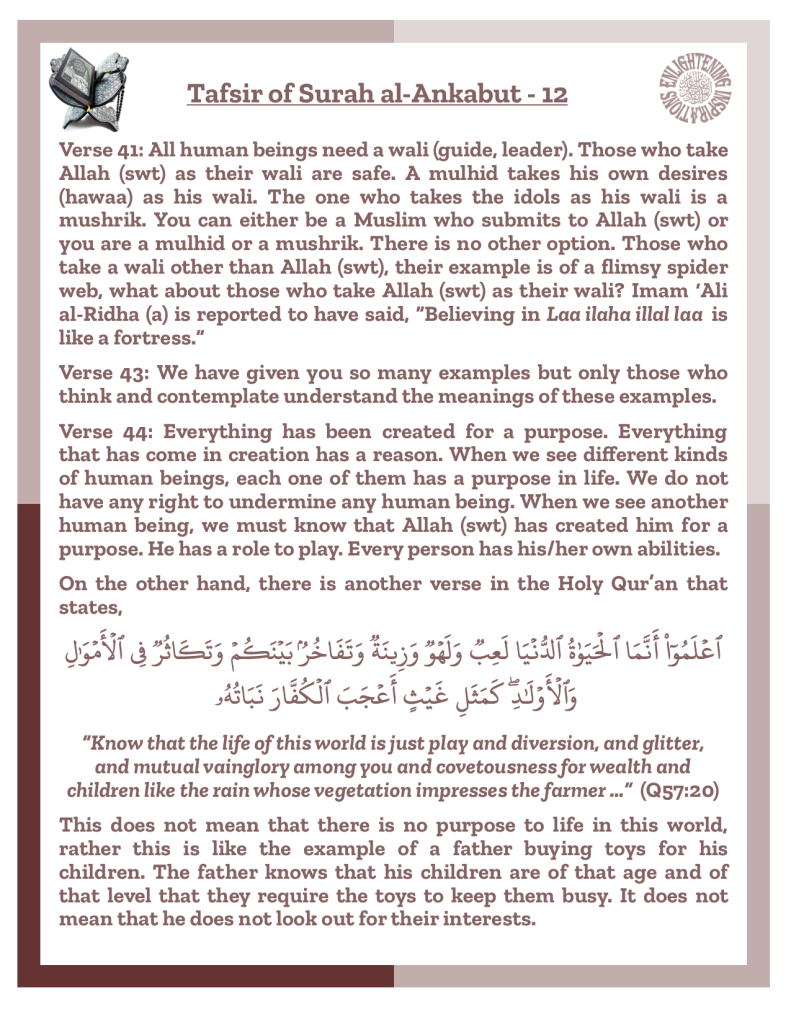
Verse 41: All human beings need a wali (guide, leader). Those who take Allah (swt) as their wali are safe. A mulhid takes his own desires (hawaa) as his wali. The one who takes the idols as his wali is a 
mushrik. You can either be a Muslim who submits to Allah (swt) or you are a mulhid or a mushrik. There is no other option. Those who take a wali other than Allah (swt), their example is of a flimsy spider web, what about those who take Allah (swt) as their wali? Imam ‘Ali 
al-Ridha (a) is reported to have said, “Believing in Laa ilaha illal laa  is like a fortress.”
Verse 43: We have given you so many examples but only those who think and contemplate understand the meanings of these examples. 
Verse 44: Everything has been created for a purpose. Everything 
that has come in creation has a reason. When we see different kinds of human beings, each one of them has a purpose in life. We do not have any right to undermine any human being. When we see another human being, we must know that Allah (swt) has created him for a purpose. He has a role to play. Every person has his/her own abilities.

Tafsir of Surah al-Ankabut  – 11

March 17, 2025 / editor
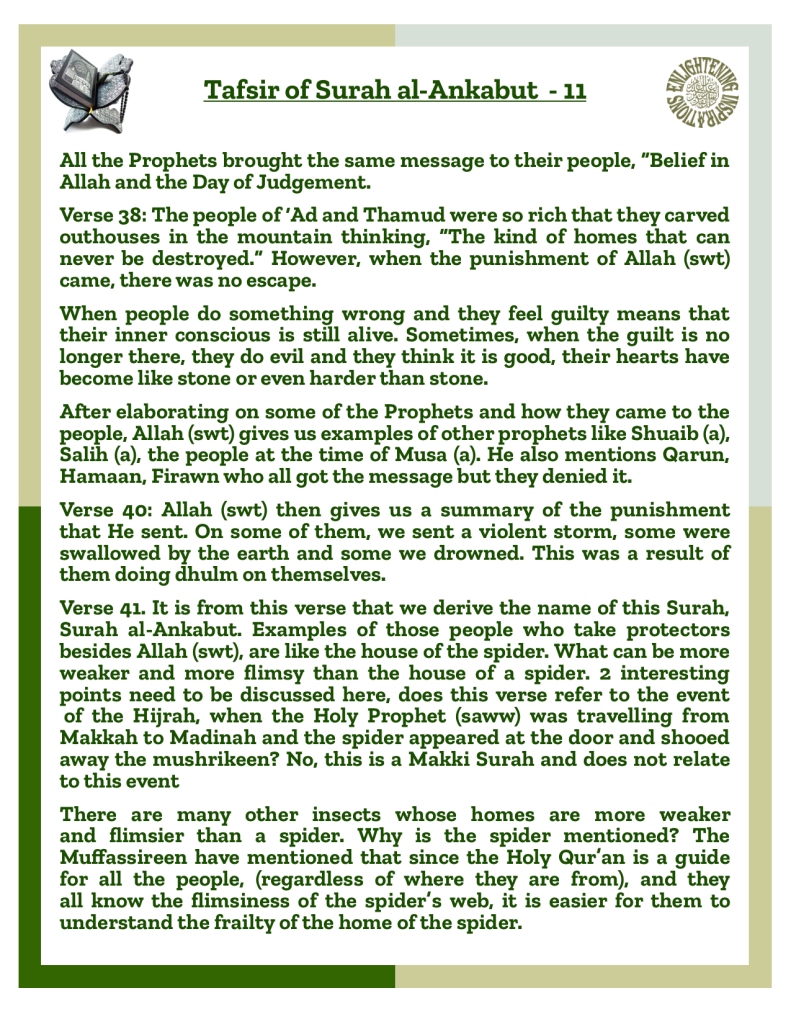
Verse 40: Allah (swt) then gives us a summary of the punishment 
that He sent. On some of them, we sent a violent storm, some were swallowed by the earth and some we drowned. This was a result of them doing dhulm on themselves. 
Verse 41. It is from this verse that we derive the name of this Surah, Surah al-Ankabut. Examples of those people who take protectors 
besides Allah (swt), are like the house of the spider. What can be more weaker and more flimsy than the house of a spider. 2 interesting points need to be discussed here, does this verse refer to the event
 of the Hijrah, when the Holy Prophet (saww) was travelling from Makkah to Madinah and the spider appeared at the door and shooed away the mushrikeen? No, this is a Makki Surah and does not relate to this event
There are many other insects whose homes are more weaker 
and flimsier than a spider. Why is the spider mentioned? The Muffassireen have mentioned that since the Holy Qur’an is a guide for all the people, (regardless of where they are from), and they 
all know the flimsiness of the spider’s web, it is easier for them to 
understand the frailty of the home of the spider.
Tafsir Surat al-Ankabut 4

Tafsir of Surah al-Ankabut – 10

March 17, 2025 / editor
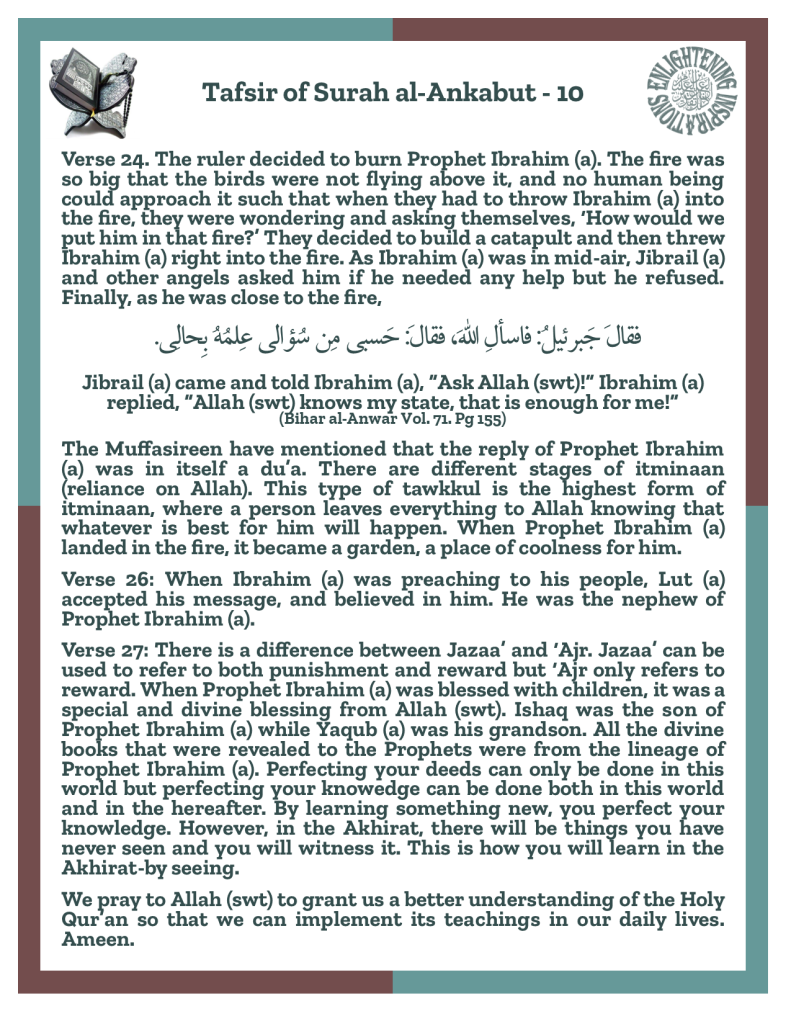
The Muffasireen have mentioned that the reply of Prophet Ibrahim (a) was in itself a du’a. There are different stages of itminaan (reliance on Allah). This type of tawkkul is the highest form of itminaan, where a person leaves everything to Allah knowing that whatever is best for him will happen. When Prophet Ibrahim (a) 
landed in the fire, it became a garden, a place of coolness for him. 
Verse 26: When Ibrahim (a) was preaching to his people, Lut (a) 
accepted his message, and believed in him. He was the nephew of Prophet Ibrahim (a). 
Verse 27: There is a difference between Jazaa’ and ‘Ajr. Jazaa’ can be used to refer to both punishment and reward but ‘Ajr only refers to reward. When Prophet Ibrahim (a) was blessed with children, it was a special and divine blessing from Allah (swt). Ishaq was the son of Prophet Ibrahim (a) while Yaqub (a) was his grandson. All the divine books that were revealed to the Prophets were from the lineage of Prophet Ibrahim (a). Perfecting your deeds can only be done in this world but perfecting your knowedge can be done both in this world and in the hereafter. By learning something new, you perfect your knowledge. However, in the Akhirat, there will be things you have never seen and you will witness it. This is how you will learn in the Akhirat-by seeing. 
We pray to Allah (swt) to grant us a better understanding of the Holy Qur’an so that we can implement its teachings in our daily lives. Ameen.

Tafsir of Surah al-Ankabut  – 9

March 17, 2025 / editor
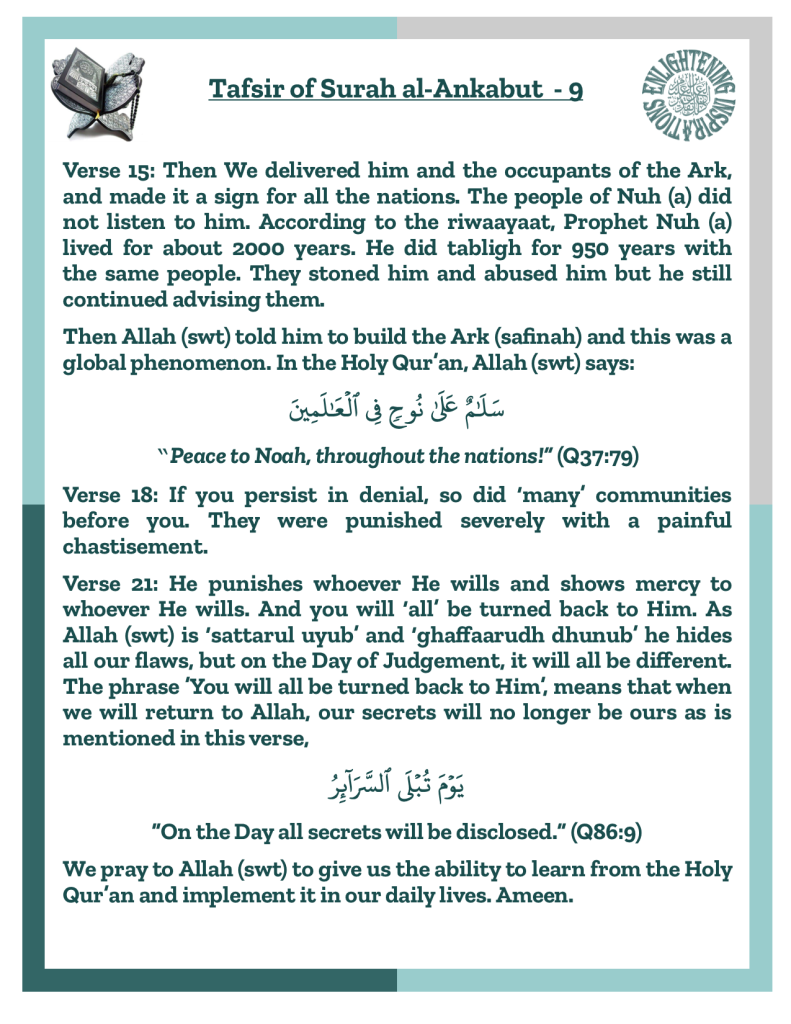
Verse 18: If you persist in denial, so did ‘many’ communities 
before you. They were punished severely with a painful 
chastisement. 
Verse 21: He punishes whoever He wills and shows mercy to 
whoever He wills. And you will ‘all’ be turned back to Him. As 
Allah (swt) is ‘sattarul uyub’ and ‘ghaffaarudh dhunub’ he hides all our flaws, but on the Day of Judgement, it will all be different. The phrase ’You will all be turned back to Him’, means that when we will return to Allah, our secrets will no longer be ours

Tafsir of Surah al-Ankabut – 8

March 17, 2025 / editor
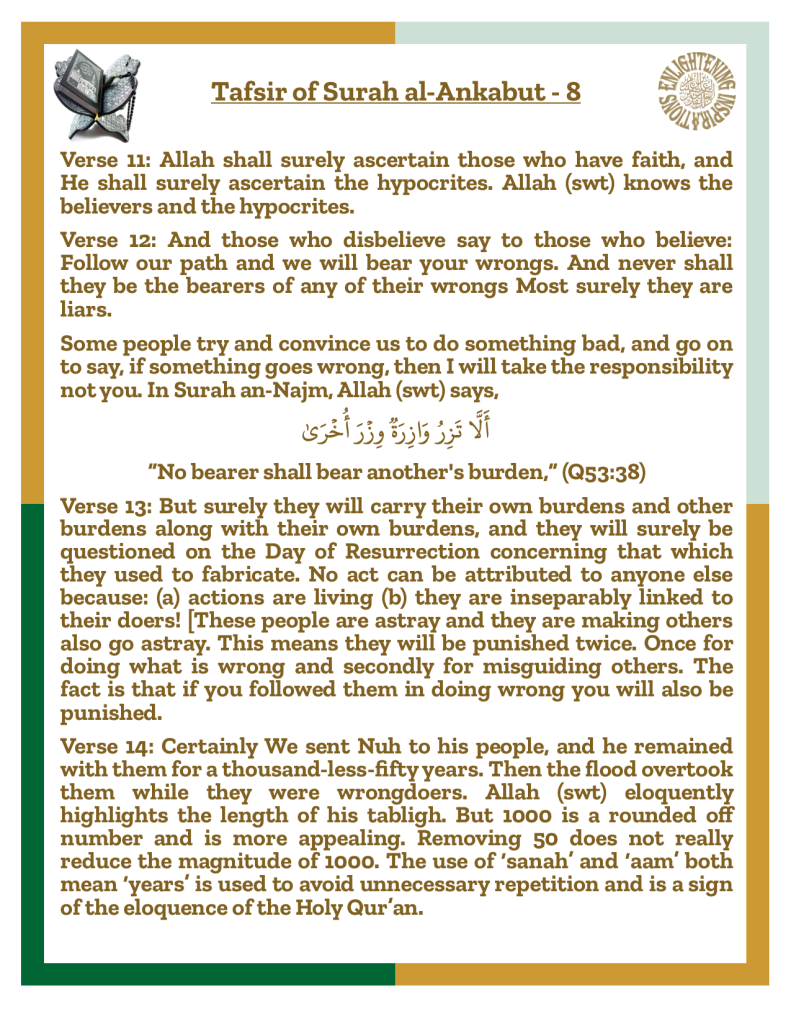
Verse 13: But surely they will carry their own burdens and other burdens along with their own burdens, and they will surely be questioned on the Day of Resurrection concerning that which they used to fabricate. No act can be attributed to anyone else because: (a) actions are living (b) they are inseparably linked to their doers! [These people are astray and they are making others also go astray. This means they will be punished twice. Once for doing what is wrong and secondly for misguiding others. The fact is that if you followed them in doing wrong you will also be punished. 
Verse 14: Certainly We sent Nuh to his people, and he remained with them for a thousand-less-fifty years. Then the flood overtook them while they were wrongdoers. Allah (swt) eloquently highlights the length of his tabligh. But 1000 is a rounded off number and is more appealing. Removing 50 does not really reduce the magnitude of 1000. The use of ‘sanah’ and ‘aam’ both mean ‘years’ is used to avoid unnecessary repetition and is a sign of the eloquence of the Holy Qur’an.

Tafsir of Surah al-Ankabut – 7

March 17, 2025 / editor
Verse 9: Those who have faith and do righteous deeds, We will surely admit them among the righteous.
Ayatullah Jawadi Amuli says that there is a difference between a person who is a Salih (righteous) and a person who is included with the Saaliheen. You can be Salih when you do an action that makes you a Salih but when you are amongst the Saaliheen, then it means you are a person for whom it hasbecome a malaka - you only do good deeds. The only thing that comes from you is righteous actions.
Verse 10: Among the people there are those who say, ‘We have faith in Allah,’ but if such a one is tormented in Allah's cause, he takes persecution by the people for Allah's punishment. Yet if there comes any help from your Lord, they will say for sure," We were 
indeed with you." Does not Allah know best what is in the hearts of the creatures?
Some people believe in Allah only by their tongue. When the 
difficulties come, they change.  When they have to suffer for the sake of Allah, then it becomes very difficult for them.  Note that these people ‘say’ that they believe. They deem the [threat of] hardships of this life as hindrance to their faith – just as the threat of chastisement is a hindrance to sin. These people believe in the benefit and the profit, not in Allah!

Tafsir of Surah al-Ankabut – 6

March 16, 2025 / editor
Verse 6: Whoever strives, strives only for his own sake. Indeed Allah has no need of the creatures. Allah (swt) does not need 
anything from us. He neither needs our struggles, nor our hard work. This means that whoever struggles, he does it for himself. The ulama and muffassireen have mentioned that this verse talks about Jihad al-Asghar (the Smaller Jihad) where the people take their weapons and fight the enemy.  
When we believe and then do good deeds, 3 things happen: The first thing is that Allah (swt) wipes away our bad deeds. The 
second thing is that we will be rewarded based on the best of what we did. Like sometimes when we go to the grocery store to buy fruits, we choose the best of what is available. Similarly we will all be rewarded based on the best of what we have done.
The third thing is that Allah (swt) will include us among the 
swaliheen  (to be explained in verse 9). We pray to Allah (swt) to grant us the correct understanding of the Holy Qur’an and help us to be amongst those who are good and also do good deeds. Ameen.

Tafsir of Surah al-Ankabut – 5

March 16, 2025 / editor
Verse 3: When Allah (swt) addresses His believers, He gives them examples of those who came before them. Do you think that only you are suffering and that the people who came before you had an easy time? Some of the muffasireen (commentators) have mentioned that this verse is referring to the tribulations of Ammar ibn Yasir. The believers were suffering and some of them considered leaving Islam. They were told to look at those who came before, like Ammar. He lost his parents - they were both martyred; the first martyrs of Islam, Sumayya and Yasir.  May Allah be pleased with them. 
Verse 4: Do they think that if they do something evil, they can 
outmaneuver (run away from) Us? Evil is the judgement that they make. Imam ‘Ali (a) is reported to have said, “The parts of your body are the army of Allah.” Your body is working for Allah, Your eyes and ears are His witnesses, they will bear testimony. Human beings 
cannot escape if they sin. 
Verse 5: Whoever hopes to meet Allah, the term appointed by Allah will then most surely come, and He is the Hearing, the Knowing.

Tafsir of Surah al-Ankabut – 4

March 16, 2025 / editor
This surah has 69 Ayaat which we InshaAllah intend to complete, we may not be able to go into the depth of every single verse. Our intention is that we provide a basic understanding of this surah so that when we recite this Surah on the night of Qadr, we understand what we are reciting. 
The first thing that Allah (swt) does in this surah after the Huruf al-Muqatta’at, He asks a question. Do the people think that if they say ‘We have faith’, they will not be tested? This is 
a rhetorical question meaning that Allah (swt) does not want you to answer. He is telling you that even though you say, “We have faith!” you will still be tested. Human beings face different types of fitnah (tribulations) in their lives
« Older posts Newer posts »

Recent Posts

  • Lessons from Du’a al-Tawbah (31) from Sahifa Sajjaddiyya with reference to the Holy Qur’an –1, 2, 3 & 4
  • Crying for Imam al-Husayn (a)
  • Ayatullah Shaykh Muhammad Ishaq al-Fayyadh
  • “A Reflection of Divine Unity and Victory: The Panjtan’s Role in Eid al-Mubahala”
  • The Immaculate Etiquette of Imam Muhammad al-Baqir (a)

Recent Comments

No comments to show.

Archives

  • July 2026
  • October 2025
  • September 2025
  • August 2025
  • July 2025
  • June 2025
  • May 2025
  • April 2025
  • March 2025
  • February 2025
  • January 2025
  • December 2024
  • November 2024
  • October 2024
  • September 2024
  • August 2024
  • July 2024

Categories

  • Ahadith/ Sayings
  • Ahlulbayt (a)
  • Blessed Month of Dhil Qa'dah
  • Blessed Month of Dhul Hijjah
  • Daily Ziyaarah
  • Du'a
  • Du'a No. 31
  • Du'a No. 7
  • Eid al Mubahala
  • Holy Prophet (s)
  • Holy Qur'an
  • Imam al-Baqir (a)
  • Imam al-Hasan (a)
  • Imam al-Husayn (a)
  • Imam al-Jawad (a)
  • Imam al-Mahdi (ajtf)
  • Imam al-Sajjad (a)
  • Imam Ali (a)
  • Imam Ali al-Hadi (a)
  • Imam Ali al-Ridha (a)
  • Imam Ja'far al-Sadiq (a)
  • Imam Musa al-Kadhim (a)
  • Inspirations
  • Issue No. 1
  • Janabe Fatimah (sa)
  • Muharram
  • Noor Magazine
  • Others
  • Prophet Ayyub (a)
  • Prophet Dawud (a)
  • Prophet Hud (a)
  • Prophet Ibrahim (a)
  • Prophet Idris (a)
  • Quality of Life
  • Safar Daily Du'a
  • Sahifa Sajjadiyya
  • Scholars
  • Stories of the Prophets
  • Supplications
  • Surat al-Ankabut
  • Tafsir
  • The Blessed Month of Rajab
  • The Blessed Month of Ramadhan
  • The Blessed Month of Sha'baan
  • Uncategorized

© 2026 Enlightening Inspirations

Theme by Anders Noren — Up ↑